Weldcom
Welding & pipefitting subcontractor for shipyards — four-language site in EN, ET, FI and RU, almost no JavaScript, crew request form on a Cloudflare Worker
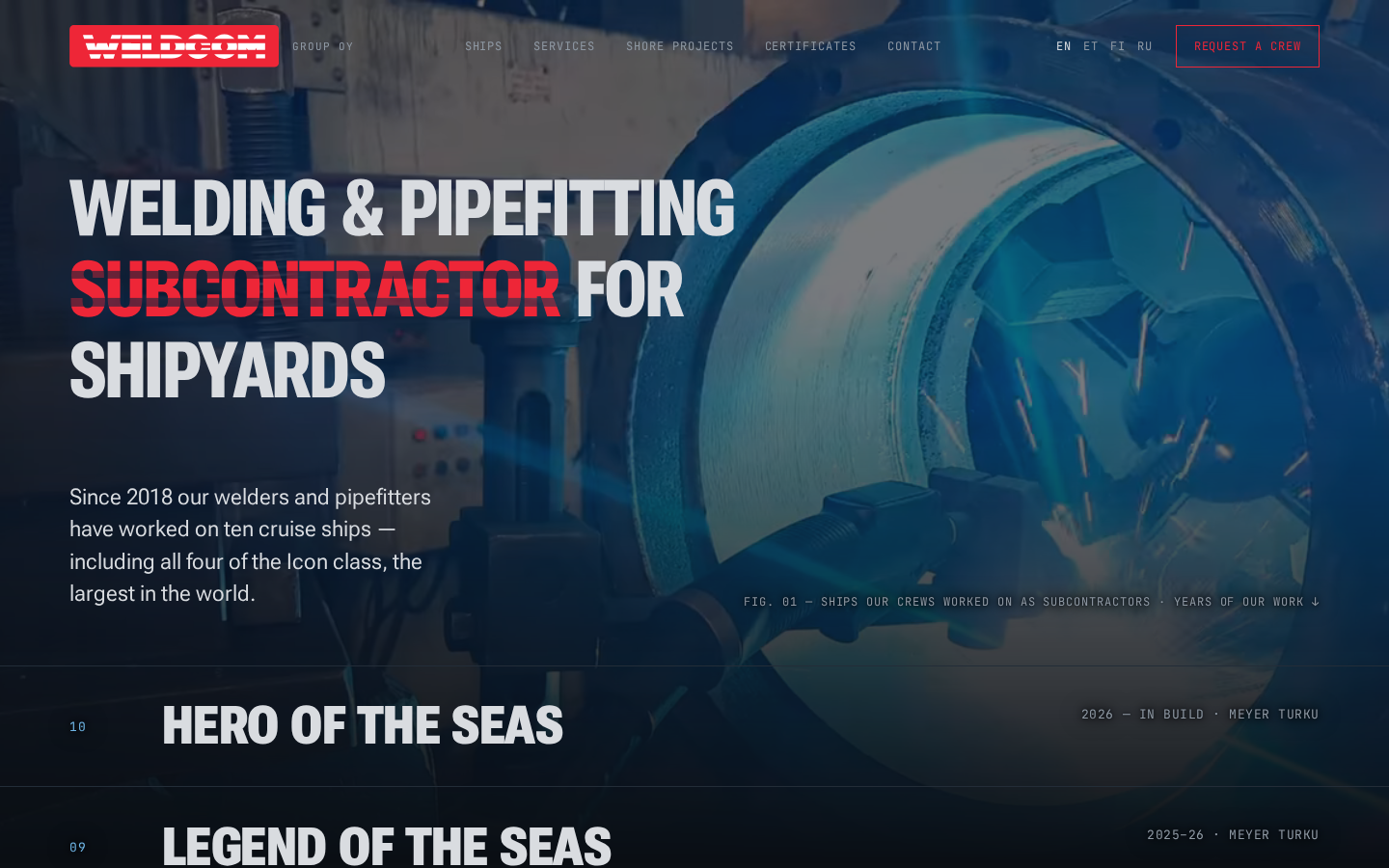
Weldcom sends welders, pipefitters and installation crews to shipyards and building sites. The company was founded in Tallinn in 2009 and has a Finnish entity, Weldcom Group Oy, since 2023. Since 2018 its crews have worked on ten cruise ships at Meyer Turku, Rauma, Rostock and Wismar, including all four ships of the Icon class, the largest in the world.
The buyers are shipyard and subcontractor managers in Finland, Germany and Estonia. Before they send a request, they want to see the ships, the yards, the certificates and the registry details, and they read the site in English, Finnish, Estonian or Russian.
Challenge
A crew subcontractor has nothing to sell on a shelf. The proof is the work: which ships, which yards, which years. All of that had to fit on one page that a project manager can scan in a minute, in four languages and with the same facts in each.
The two companies, Estonian and Finnish, have different registry codes, VAT numbers and permits. A Finnish yard checks the Finnish company in the YTJ register before it lets a crew on board, so the details had to be exact and link to the official registers.
Many visitors open the site on a phone, on site or on a mobile connection. A heavy page with a video background and a large photo gallery would load slowly exactly where these people are.
Solution
One page in four languages: English at the root, Estonian, Finnish and Russian under /et/, /fi/ and /ru/, with hreflang and a sitemap. The ships the crews worked on are drawn as silhouettes at build time from a data file. A map shows great-circle distances from Tallinn to each yard, and the shore projects in Estonia and the partners are listed by year. Both companies appear with registry codes, VAT numbers and links to e-Äriregister and YTJ, and the same facts go into Organization JSON-LD.
The page runs almost without JavaScript. The photo lightbox uses the Popover API, the form opens with a <details> element, the menu uses :target, and the counters and the section dock are scroll-driven CSS. The only script is Cloudflare Turnstile on the form, and it loads only when needed. Photos are served as AVIF and WebP in several sizes. The background welding video, about 1.2 MB, is replaced by a still image for reduced motion and removed entirely for visitors with Save-Data turned on. The headings use a cut-down Roboto Flex, and the fallback fonts are metric-matched, so the font swap does not move the layout.
The crew request form posts to a Cloudflare Worker. The Worker checks a honeypot field, applies a rate limit, validates the fields, verifies Turnstile and sends the request by email through Resend, with Reply-To set to the sender. No personal data is logged. The site also has /llms.txt, generated from the same dictionaries and company data as the pages, so AI search tools get the same facts as a visitor. It is deployed to the client's own Cloudflare account on weldcom.eu.